
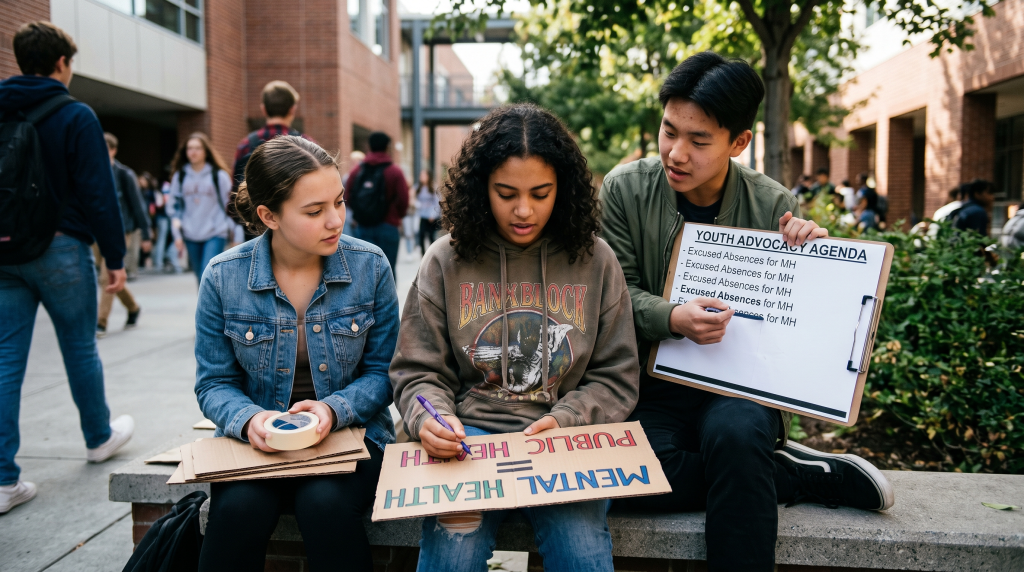
There’s a familiar script most teens know by heart: push through, stay on schedule, don’t fall behind. But a growing number of young people are pushing back, and not just venting to their friends. They’re advocating for real, structural change, starting with something surprisingly simple: the right to take a day off when their mental health demands it.
It’s a movement worth paying attention to.
The Reality Behind the Report Cards
Teens today are under enormous pressure. Academic pressure ranks as the top stressor for California teens, followed closely by lack of sleep, high parental expectations, and a relentless schedule that leaves little room to breathe. One student summed up their peers’ experience bluntly: “Wake up, stress out, push through, burn out.” Aimymh
The numbers back that up. In 2023, 40% of high school students stopped regular activities because of persistent feelings of sadness or hopelessness, and one in five seriously considered attempting suicide. These aren’t just statistics on a page. They represent real kids in real classrooms, many of whom feel they have no safe outlet. CDC
Nearly 60% of teens report experiencing some form of mental health challenge, such as anxiety or depression. And yet the systems meant to support them often fall short. Only 11.6% of students say they’re likely to use the school counseling resources available to them, and nearly two-thirds feel hesitant, citing fears of judgment and concerns about confidentiality. DC Public SchoolsAimymh
Something has to give.
Teens Who Decided to Do Something About It
When adults weren’t moving fast enough, some teens decided to take the lead themselves.
The most well-known example came out of Oregon, where four teen activists championed a proposed state law that would allow students to take mental health days just as they would sick days. Their effort worked. Oregon schools now excuse student absences for mental or behavioral health reasons, widely believed to be one of the first laws of its kind in the country to treat physical and mental health equally. NPRNPR
One of those advocates, Hailey Hardcastle, kept her eyes on the bigger picture. “I have three younger sisters who are in middle school right now,” she said. “Part of the reason I do this is so that high school and beyond will be even easier for them than it was for me.” NPR
That’s the spirit behind this whole movement: teens advocating not just for themselves, but for the kids who come after them.
A Growing Push for Policy Change
Oregon wasn’t alone for long. Since 2020, 10 states have passed laws allowing students to take a day off from school not because they are physically ill, but simply to mentally rest and recharge. States that now recognize mental health as a valid reason for an excused absence include Arizona, California, Colorado, Connecticut, Illinois, Oregon, Utah, Virginia, and Washington, among others. EdWeekTELEMYND
The specifics vary by state. Some laws simply state that mental or behavioral health is a valid excuse for missing school. Connecticut allows up to two non-consecutive mental health days per year, and Illinois allows up to five. EdWeek
The bipartisan support is notable. These bills have been sponsored by both Democrats and Republicans, which signals that concern for teen mental health cuts across political lines. EdWeek
Still, there’s a long way to go. In 36 states, mental health is still not recognized as an excused absence from school. Children from lower-income households are three times less likely to be enrolled in a school where mental health days are available. Office Practicum
Are Mental Health Days Actually Helpful?
It’s a fair question. A day off isn’t therapy, and no one is claiming it is.
Clinical child psychologist Christine M. Nicholson supports the effort, noting that kids sometimes need to step away, go for a hike, see a movie, or simply rest at home. “Mental health has to be appreciated as much as physical health,” she said. “Kids are having a tough time, and they need a break.” The Washington Post
In one survey of over 1,000 parents, 75% said that mental health days “can be an effective tool to support a child’s mental health.” And for many families, simply having the policy in place sends a signal that matters: it communicates that taking care of your mental health is as important as your physical health, and it reduces stigma around seeking help. Office PracticumEdWeek
That said, experts are clear that these days aren’t a cure. As one clinical psychologist noted, “We’re not going to solve the youth mental health crisis with a few mental health days. But it’s a great starting point.” The Washington Post
The goal is to pair this kind of policy with real, accessible resources.
What Parents and Caregivers Can Do
Whether your teen’s state has a mental health day policy or not, there’s a lot adults can do right now.
Listen without judgment. When a teen says they’re struggling, the first response matters. Resist the impulse to problem-solve immediately. Just hearing them out goes a long way.
Take the request seriously. If your teen asks for a day to recharge, consider it. Among parents who let their children take a mental health day, 77% felt the day had a positive impact. That’s a meaningful number. CNBC
Know when it’s more than a bad week. A day off is appropriate for stress and burnout. But if your teen is regularly unable to function, withdrawing from people they love, or expressing hopelessness, that’s a sign that professional support is needed, not just a rest day.
Support their advocacy. If your teen is passionate about mental health awareness at their school, encourage it. Research shows that teens want youth-led campaigns and peer speakers who talk openly about mental health in ways that feel real. When teens drive these conversations, other teens actually listen. Aimymh
When to Seek Professional Support
Mental health days are a tool, not a solution. Watch for signs that your teen may need more than a day of rest:
- Persistent sadness or hopelessness lasting more than two weeks
- Significant changes in sleep, appetite, or energy
- Withdrawal from friends, family, or activities they used to enjoy
- Declining school performance despite trying
- Talk of feeling worthless, hopeless, or not wanting to be here
If you notice these signs, reach out to your teen’s pediatrician or a licensed mental health professional. Early support makes a real difference.
A Final Word
The teens fighting for mental health days aren’t asking for a free pass. They’re asking for the same basic acknowledgment that adults have long given themselves: that the mind needs care just as much as the body does.
At Nurturing Tomorrow Foundation, we believe young people deserve to be heard, supported, and equipped with the tools to thrive. The next generation is already advocating for a healthier world. The least we can do is listen.
Sources
- AIM Youth Mental Health. “State of Youth Mental Health 2025: California Teens Are Demanding a Mental Health Revolution.” https://aimymh.org/state-of-youth-mental-health-2025-california-teens-are-demanding-a-mental-health-revolution/
- Centers for Disease Control and Prevention. “CDC Launches New Campaign to Address Youth Substance Use and Mental Health.” https://www.cdc.gov/media/releases/2025/2025-cdc-launches-new-campaign-to-address-youth-substance-use-and-mental-health.html
- Centers for Disease Control and Prevention. “CDC Data Show Improvements in Youth Mental Health but Need for Safer and More Supportive Schools.” https://www.cdc.gov/media/releases/2024/p0806-youth-mental-health.html
- DC Public Schools School Mental Health. “Mental Health for Students and Families in 2025.” https://dcpsmentalhealth.org/mental-health-for-students-and-families-in-2025-understanding-supporting-and-thriving/
- Education Week. “More Schools Are Offering Student Mental Health Days. Here’s What You Need to Know.” https://www.edweek.org/leadership/more-schools-are-offering-student-mental-health-days-heres-what-you-need-to-know/2023/01
- National Academy for State Health Policy. “States Take Action to Address Children’s Mental Health in Schools.” https://nashp.org/states-take-action-to-address-childrens-mental-health-in-schools/
- NPR. “Teen Activists Lead an Effort in Excusing ‘Mental Health Days’ in Oregon Schools.” https://www.npr.org/2019/07/22/744074390/feeling-blue-oregon-students-allowed-to-take-mental-health-days
- Office Practicum. “The Case for Student Mental Health Days in America’s Schools.” https://www.officepracticum.com/blog/the-case-for-student-mental-health-days-in-americas-schools/
- TELEMYND. “Which States Allow Mental Health Days for Students?” https://mytime.telemynd.com/telemyndblog/which-states-allow-mental-health-days-for-students/
- The Washington Post. “More States Are Allowing Children to Take Mental Health Days.” https://www.washingtonpost.com/health/2022/10/02/student-mental-health-days/