


Part 1 of a Series on Understanding and Supporting Children with Anxiety
“But There’s Nothing to Worry About…”
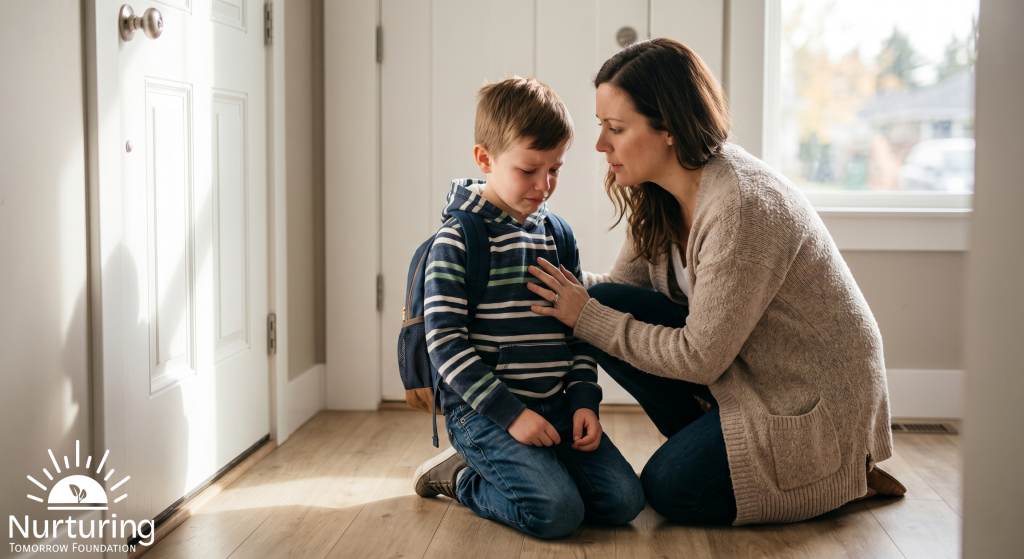
Your child is standing by the front door, backpack on, shoes tied, and tears streaming down their face.
“I don’t want to go.”
You ask what’s wrong.
“I don’t know.”
Maybe they’re worried about a test. Maybe they’re nervous about seeing friends. Maybe nothing obvious happened at all. As a parent, it can be confusing and sometimes frustrating to watch your child struggle when you can’t see a clear reason why.
Many parents find themselves wondering:
- Is this normal worrying?
- Is my child just sensitive?
- Did I do something wrong?
- Should I push them through it or give them a break?
If you’ve ever asked yourself these questions, you’re far from alone.
Anxiety is one of the most common emotional challenges children experience, yet it is also one of the most misunderstood. Understanding what anxiety is and what it isn’t, is often the first step toward helping your child feel more confident and capable.
Why This Matters
Every child worries sometimes.
A preschooler may fear monsters under the bed. A school-aged child may worry about making mistakes. A teenager may feel nervous about friendships, grades, or the future.
Worry itself is not a problem. In fact, it is part of being human.
Anxiety becomes important to pay attention to when it starts interfering with a child’s daily life, relationships, learning, or ability to do things they want or need to do.
Research supported by organizations such as the American Academy of Pediatrics and the National Institute of Mental Health suggests that anxiety can affect children’s emotional well-being, school performance, social development, and family life when it becomes persistent or overwhelming.
The good news is that anxiety is highly treatable, and children can learn skills that help them manage it effectively.
Perhaps even more important: anxiety is not a sign of weakness, poor parenting, or a child being “difficult.”
It is a common human experience that can be understood and addressed.
What Parents Should Know About Childhood Anxiety
Anxiety Is the Brain’s Alarm System
One of the simplest ways to understand anxiety is to think of it as the brain’s alarm system.
Our brains are designed to detect danger and help keep us safe. When a threat appears, the body prepares to respond by increasing alertness, raising heart rate, and focusing attention.
This system is incredibly helpful when danger is real.
The challenge is that sometimes the alarm system reacts to situations that are uncomfortable, uncertain, or unfamiliar but not actually dangerous.
For example:
- Giving a class presentation
- Joining a new sports team
- Sleeping away from home
- Taking a test
- Meeting new people
To an anxious child, these situations can feel much bigger and scarier than they appear from the outside.
Anxiety Is Different From Normal Worry
Every child experiences worry.
The difference is often a matter of intensity, frequency, and impact.
Normal worry might look like:
- Feeling nervous before a big event
- Asking a few questions for reassurance
- Recovering after the stressful situation passes
Anxiety may look more like:
- Persistent worry that is difficult to let go of
- Avoiding activities because of fear
- Significant distress before routine events
- Physical symptoms such as stomachaches or headaches
- Difficulty participating in age-appropriate activities
A useful question is not “Does my child worry?”
Most children do.
Instead ask:
“How much is this worry affecting my child’s daily life?”
Anxiety Is Not a Choice
Children do not choose anxiety.
When a child refuses a birthday party because they’re overwhelmed with worry, they are not usually trying to be difficult.
When they repeatedly ask if everything will be okay, they are not necessarily seeking attention.
Their nervous system may genuinely be signaling danger.
Understanding this distinction can help parents respond with empathy while still encouraging growth.
Anxiety Happens for Many Reasons
Parents often wonder what caused their child’s anxiety.
In reality, anxiety rarely has a single cause.
Experts generally view anxiety as the result of multiple factors interacting together, including:
- Temperament and personality
- Genetics and family history
- Life experiences
- Stressful events
- Learning patterns
- Environmental influences
Some children are naturally more cautious or sensitive to uncertainty. This does not mean something is wrong with them.
Many of the traits associated with anxiety—carefulness, conscientiousness, thoughtfulness—can also become strengths when children learn how to manage anxious feelings effectively.
What Anxiety Can Look Like at Home, School, and Socially
One reason anxiety is often missed is that it does not always look like fear.
At Home
You may notice:
- Frequent reassurance-seeking
- Difficulty separating from parents
- Trouble sleeping
- Avoiding new experiences
- Emotional meltdowns after school
- Perfectionistic behavior
- Excessive concern about mistakes
A child who appears stubborn or oppositional may actually be struggling with anxiety underneath.
At School
You may notice:
- Complaints of stomachaches before school
- Difficulty participating in class
- Avoidance of presentations or group work
- Excessive checking or perfectionism
- Trouble concentrating when worried
Teachers may see a quiet child who rarely speaks up, or a child who seems distracted because anxious thoughts are taking up so much mental space.
Socially
You may notice:
- Reluctance to join activities
- Fear of embarrassment
- Difficulty initiating friendships
- Avoidance of unfamiliar situations
- Excessive concern about what others think
It is common for children with anxiety to want connection while simultaneously feeling afraid of social risks.
Common Parent Misunderstandings
Myth #1: “They’re Just Shy”
Some anxious children are shy.
Many are not.
Anxiety can affect outgoing, energetic, and socially engaged children too.
Myth #2: “If I Protect Them From Stress, They’ll Feel Better”
Protecting children from overwhelming situations can be helpful in the short term.
However, research in child anxiety consistently shows that avoiding feared situations often strengthens anxiety over time.
Children build confidence not by avoiding challenges forever, but by gradually learning they can handle them.
We’ll explore this idea more deeply later in the series.
Myth #3: “They’ll Just Grow Out of It”
Sometimes worries naturally improve with age.
Sometimes they don’t.
Ignoring significant anxiety can allow patterns of avoidance and fear to become more entrenched.
Early understanding and support can make a meaningful difference.
Myth #4: “I Must Have Caused This”
Parents often carry unnecessary guilt.
While family environments influence children in many ways, anxiety is not simply the result of a parenting mistake.
Most parents are doing the best they can with the information and resources available to them.
The more helpful question is not:
“What did I do wrong?”
Instead ask:
“What can I do now to support my child?”
What Helps
Listen Before Solving
When children share worries, many parents instinctively jump into problem-solving.
Sometimes children first need to feel understood.
Try:
“That sounds really hard.”
“I can see why you’re feeling nervous.”
“Tell me more about what’s worrying you.”
Validation does not mean agreeing that a feared outcome will happen.
It simply means acknowledging that the feeling is real.
Research from developmental psychology suggests that children are often more receptive to guidance after they feel understood.
Focus on Building Confidence
Instead of trying to eliminate all anxiety, help your child develop confidence in their ability to handle it.
A helpful shift is:
From: “How do I make this anxiety disappear?”
To: “How do I help my child cope when anxiety shows up?”
This approach supports resilience and long-term emotional growth.
Keep Communication Open
Children are more likely to discuss worries when they feel safe from judgment.
Simple curiosity can go a long way:
- “What was the hardest part?”
- “What were you thinking in that moment?”
- “What do you think would help?”
These conversations provide valuable insight into your child’s experience.
What to Avoid
Avoid Dismissing Feelings
Comments such as:
- “Don’t worry.”
“It’s not a big deal.”
- “You’ll be fine.”
are often said with love.
However, they can unintentionally make children feel misunderstood.
Instead, try acknowledging the feeling first before offering support.
Avoid Labeling Children
Children can begin to internalize labels.
Instead of:
“She’s an anxious child.”
Consider:
“She’s experiencing anxiety right now.”
This subtle difference reinforces that anxiety is something a child experiences—not who they are.
Avoid Expecting Immediate Change
Learning to manage anxiety is a process.
Progress often happens gradually through repeated experiences, practice, and support.
Small steps matter.
Try This Week
Choose one or two of these simple actions:
- Spend five minutes each day asking about your child’s worries without immediately trying to solve them.
- Notice situations your child avoids and write them down without judgment.
- Practice validating feelings with phrases like:
- “That sounds hard.”
- “I can see why you’re nervous.”
- Look for moments when your child acts bravely, even if they still feel anxious.
- Reflect on your own responses to anxiety and consider what messages your child may be learning from them.
When to Seek Extra Support
Some anxiety is a normal part of development.
It may be helpful to seek professional support if anxiety is:
- Persistently interfering with school
- Affecting friendships
- Disrupting sleep
- Leading to significant avoidance
- Causing ongoing distress for the child or family
A pediatrician, school counselor, psychologist, or other qualified mental health professional can help determine what support may be beneficial.
Seeking help is not a sign that something has gone wrong.
It is simply another way of supporting your child’s well-being.
Looking Ahead
Understanding anxiety is the foundation for helping children navigate it.
But anxiety does not always look the way parents expect.
In the next article, we’ll explore one of the most surprising aspects of childhood anxiety: the hidden signs that many parents miss, including irritability, perfectionism, stomachaches, procrastination, and other behaviors that may not seem anxiety-related at first glance.
Further Reading / Sources
- American Academy of Pediatrics (AAP): Guidance on children’s emotional health and anxiety
- National Institute of Mental Health (NIMH): Childhood and adolescent anxiety disorders
- American Psychological Association (APA): Research on child development and anxiety
- Centers for Disease Control and Prevention (CDC): Children’s mental health resources
- Anxiety & Depression Association of America (ADAA): Understanding childhood anxiety
- Clinical practice guidelines and peer-reviewed research on pediatric anxiety and evidence-based treatment approaches