

An intro to our ADHD foundations series
If your child’s brain feels like a race car: thrilling, fast, sometimes off the track, you’re not imagining it. ADHD brains are wired for speed and novelty. The goal isn’t to slam the brakes; it’s to build a great pit crew. In family life, that pit crew is sleep, routines, and movement. This intro post sets the stage for the series with human, doable steps that are backed by solid research.
Sleep: the unseen superpower
Here’s what many parents notice: on short or irregular sleep, tomorrow is louder — more distractible, more irritable, more everything. That matches pediatric sleep research: adequate, regular sleep steadies attention and emotions in kids with ADHD. Most school‑age kids thrive on roughly 9–11 hours; teens on 8–10. The secret isn’t a perfect bedtime, it’s anchors. Keep wake‑up time fairly consistent, dim the house in the hour before bed, and build a repeatable wind‑down (screens off, lights low, the same few steps).
Try this today
- Swap rules for a routine: lights dim → PJs → brush → book → bed (same order most nights).
- If Saturday runs late, protect Sunday’s bedtime so Monday doesn’t hurt.
Routines: executive function on the outside
ADHD makes “what’s next?” feel like a pop quiz all day. Routines take that quiz off the table.When steps happen in the same order with the same cues, kids don’t have to reinvent mornings, homework, or bedtime from scratch. School‑based ADHD programs use this idea: fewer decisions in the moment free up brainpower for focus and self‑control.
Start tiny
- Pick one sticky transition (morning, homework, or bedtime).
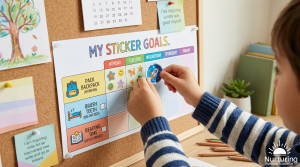
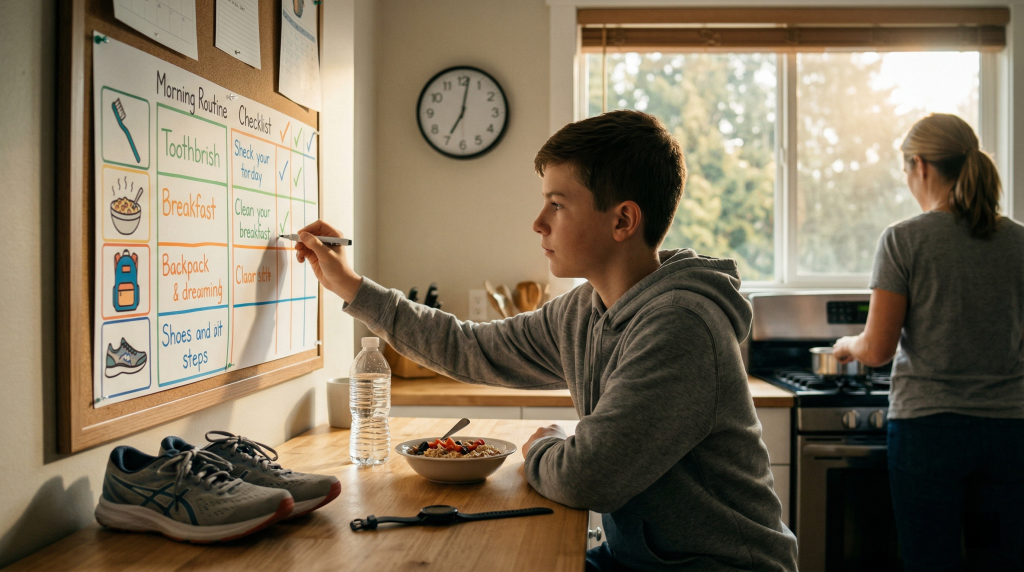
- Map 3–5 steps; put a picture checklist where your child can see it.
- Use the same cue (timer, song, or phrase) daily for two weeks.
- When it wobbles, reset, don’t lecture: “Let’s restart—what’s step one?”
Movement: short bursts, big payoff
Short bursts of activity can flip on focus like a light switch, for some kids, the effect lasts an hour or two. Studies where kids take a brisk walk or do a brief bout of aerobic play show better on‑task behavior right after. You don’t need a gym; you need 5–10 active minutes before focus‑heavy moments (school drop‑off, homework) and a 60‑second wind‑down (stretching or slow breaths) so the transition is smooth.
Make it fun
- Call it a “brain boost,” not “exercise,” and let your child choose music or activity.
- For sensory seekers, try “heavy work” like pushing a laundry basket or carrying groceries.
Real‑life tools you can use today
- Two‑step warnings: “Five minutes… one minute… then shoes.” Keep it short; give one next step.
- Sportscaster praise: “You started homework after one reminder—that’s strong focus.”
- Visual beats verbal: A photo or icon checklist by the door cuts reminders in half.
- Body‑first calm: Do 60 seconds of slow breathing together before homework or bed (exhales longer than inhales, or box breathing 4‑4‑4‑4).
Common snags (and quick fixes)
- Can’t fall asleep: Keep wake time steady; dim lights an hour before bed; move “worry time” earlier and jot fears down so the brain can clock out.
- Exercise revs them up: End with a calm‑down minute—stretching, wall push‑ups, or ten slow exhales.
- Routine falls apart: Trim steps (if there are eight, try four). Keep cues consistent. Consistency beats creativity here.
How you’ll know it’s working Look for 10% better, not perfect: fewer prompts to start homework, a calmer last 30 minutes before bed, a smoother launch out the door. Track one tiny metric (like “minutes to shoes on”) for a week. If the trend is down, you’re on the right road.
When the basics aren’t enough If mornings feel like a daily crisis, school is calling often, or mood storms dominate most days, loop in your pediatrician, a behavioral therapist, or the school team. Foundations help almost everyone, and some kids need additional supports—that’s a strength move, not a failure.
What’s next in the series
- Sticker Charts That Actually Work: The Psychology of Praise, Rewards, and Consequences
- Big Feelings, Small Steps: Meltdown Prevention and Co‑Regulation
- School Is a Team Sport: Winning with 504s, IEPs, and Classroom Hacks
- ADHD Treatment Decoded: Meds, Therapy, and Data‑Informed Decisions
Further reading (parent‑friendly)
- American Academy of Pediatrics — Healthy Sleep for Kids
- Why it matters: Consistent, adequate sleep is linked to steadier attention and mood; most 6–12‑year‑olds need 9–12 hours, teens 8–10.
- AAP HealthyChildren sleep pages: https://www.healthychildren.org/English/healthy-living/sleep/Pages/default.aspx.
- CDC — Children’s Mental Health: ADHD
- Why it matters: Multimodal care: behavioral parent training, school accommodations, and when indicated, medication, has the strongest evidence for improving daily functioning.
- CDC ADHD parent pages: https://www.cdc.gov/adhd/treatment/behavior-therapy.html.
- Child Mind Institute — ADHD Guides for Families
- Why it matters: Visual schedules, specific praise, and predictable routines reduce cognitive load and improve follow‑through.
- Child Mind Institute ADHD hub: https://childmind.org/topics/adhd-attention-problems/?gad_source=1&gad_campaignid=23480498315&gbraid=0AAAABCCOvtKStJF-XDnaLnU713W4WL4y4&gclid=EAIaIQobChMI646diJGqkwMVLGlHAR3jhhgoEAAYASAAEgLtGvD_BwE.
- Understood.org — Executive Function and School Supports
- Why it matters: External scaffolds (checklists, timers, chunked tasks) improve on‑task behavior and independence in elementary‑age students with ADHD.
- https://www.understood.org/en/topics/adhd.
This article was written by Xizhi Chan. Xizhi Chan is a physician–scientist who channels clinical and research expertise to make science understandable and usable for everyone. She is passionate about advancing human health and well‑being, both mental and physical, focusing on accessible, evidence‑based initiatives that translate knowledge into compassionate, real‑world support for individuals and communities.