
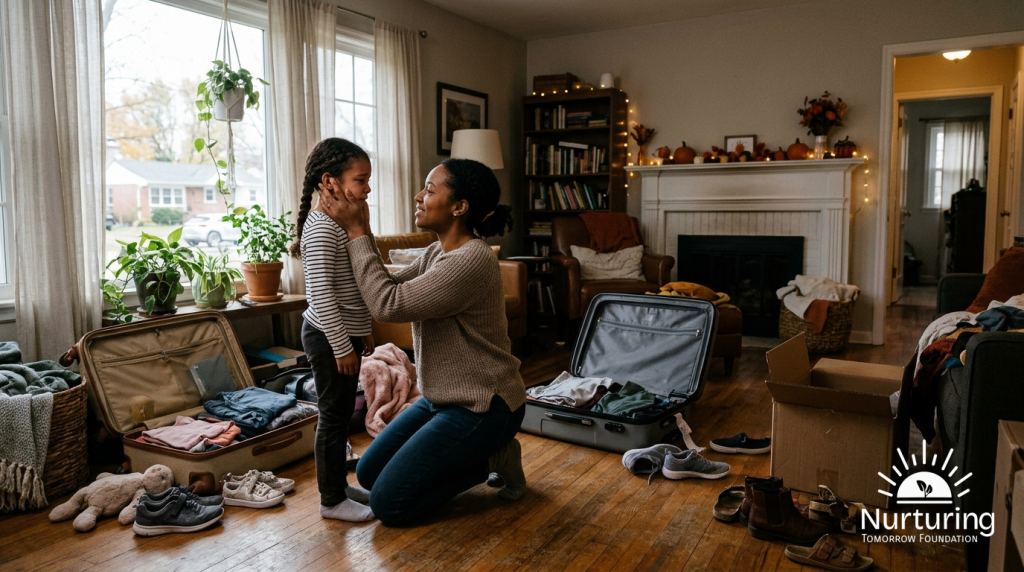
It’s the Tuesday before Thanksgiving. The car is half packed, someone can’t find a shoe, and your seven-year-old has just announced, tearfully, that she does not want to go to Grandma’s. You had pictured cozy pie and cousins. What you’ve got is a kid melting down in the hallway and a quiet voice in your head asking what you’re doing wrong.
Nothing, most likely. Breaks from school sound restful, but for kids they often mean a lot of change at once. And for the adults managing it, they can mean a lot of pressure. A TulsaKids Magazine interview with a Tulsa psychiatric practice puts it plainly: kids are out of school, routines are disrupted, family may be visiting, and social engagements fill the calendar. The holidays, they note, are not going to be “absolutely perfect.”
The good news is that Thanksgiving break is still a few weeks away. That’s enough time to set honest expectations, prepare your kids, and decide what really matters to your family. Here’s how to do it.
The Reality: Lots of Small Changes Add Up
One note before we begin. None of the research we drew on is specifically about Thanksgiving. Much of it covers holidays and school breaks in general, and some comes from back-to-school and summer transitions. We’ve applied it to Thanksgiving thoughtfully, but it’s a reasonable inference, not a proven formula.
An ABA provider, Kids Club ABA, describes what a holiday can involve: long car rides, crowded homes, unfamiliar food, late nights and many new faces. Sleep and mealtimes shift. Kids may be asked to sit through long meals, greet relatives or wear clothes that feel strange. Each change takes effort, and as the provider notes, “Several changes together can quickly add up.”
That source focuses especially on children who rely on routine, including autistic children. But the idea applies more widely. A child who seems to be “misbehaving” at the table may simply be tired, overstimulated and out of their usual rhythm.
A homeschool organization, the Texas Home School Coalition, adds that excitement, sugary foods and schedules “going out the window” can bring out less-than-ideal behavior. In other words, a rough moment doesn’t mean something is wrong with your child.
Grown-Ups Feel It Too
Holiday stress is common among adults, so it’s worth naming. A counseling practice, Carbajal Counseling, cites a 2023 American Psychological Association poll in which 89% of U.S. adults said something causes them holiday stress. The top sources were money (58%), finding the right gifts (40%), missing loved ones (38%), having too much to do (32%) and pressure to make the holidays special (30%). Family conflict (22%) and feeling left out (20%) were on the list too.
That same practice points out that much of this is about expectations, grief, money and exhaustion, not about the people at the table. It also explains why tension can rise when families gather. Adults slide back into childhood roles. Relatives who rarely see each other sit together for hours. Grief feels louder. Differences in beliefs and parenting styles become more visible. Divorced, blended and in-law families add logistics and divided loyalties.
If that sounds familiar, you’re in good company. None of our sources look at whether children absorb their parents’ stress, so this next point is our own inference. The nearest support is a school-transitions guide for educators, which says an adult’s calm, regulated presence helps a student return to calm faster. We think the same may hold at home, which is one more reason to go easy on yourself.
Let Go of the Picture-Perfect Version
Social media may add to the pressure. An Australian psychology practice, writing about school holidays, describes social media as a “carefully selected window” into other families’ lives. It cites research finding that mothers who make more parenting-related comparisons online tend to report poorer mental health and less positive feelings about their parenting (Coyne and colleagues, 2017). That is an association, not proof of cause, and those studies focused on mothers, but the practice suggests the pressure to compare may be felt by parents and caregivers more broadly.
Their advice is simple: decide what matters to your own family, and plan connection rather than constant entertainment. A walk, cooking together, a trip to the playground or a movie night all count. An expensive or activity-packed holiday, they say, “is not a measure of good parenting.”
The TulsaKids piece says it well: “Choose presence over perfection.” Kids won’t remember whether the table looked perfect. The holiday bloopers are often the stories that last for years.
What to Do Now, Before the Break
A little preparation can take the edge off. Here is what the sources suggest.
Simplify and choose
A physician-authored guide from Fever Coach recommends simplifying plans, choosing which invitations matter most and leaving open time between visits. The Texas Home School Coalition adds that it’s okay to say “no” when you’re stretched thin, and to keep bedtimes. Carbajal Counseling suggests naming your own triggers and picking a couple of non-negotiables, the things that matter most to you, and letting the rest be flexible.
Preview what will happen
Fever Coach suggests telling kids ahead of time where you’re going, who will be there and when you expect to leave. Kids Club ABA offers some concrete tools. It frames them as ABA strategies for children who depend on predictability, and it recommends a BCBA to build a plan around a child’s specific needs. We think some of them may also help other children, but that is our own inference, not something the source says:
- Show photos of the place or the people.
- Use a simple visual schedule, such as “car, Grandma’s house, lunch, play, car, home.”
- Read or write a short story about what the day will look like.
- Practice small pieces ahead of time, like a longer car ride, trying on the outfit, or role-playing waiting in line.
- Pack a comfort kit: headphones, a snack, a comfort object, a favorite activity and a change of clothes.
Learn from last year
The Texas Home School Coalition suggests listing what didn’t go well last Thanksgiving and Christmas, then fixing it. If the kids got antsy because the meal was late, its suggestion is to prepare some dishes the day before, or even days before and freeze them, to keep waiting time down. (Having kids eat a snack first or bring something to do are our own ideas, not the source’s.) Small fixes can make a real difference.
During the Break: Keep a Few Anchors
Fever Coach says the American Academy of Pediatrics explains that regular routines support children’s mental and emotional development. You can’t hold every routine in place during a holiday, and you don’t have to. Kids Club ABA suggests keeping two or three “anchor” routines, such as the bedtime routine, a familiar breakfast or a short daily activity your child enjoys, so a child feels steady. Fever Coach similarly advises keeping bedtime, wake-up time and meals reasonably close to their usual times.
Some sources lean toward sticking to routines, and others toward letting go of perfection. These fit together. Keep a few anchors, and when a late night happens, return to routine afterward without treating it as a failure.
Plan an easy exit and quiet breaks
Decide ahead of time how you could shorten a visit if you need to. If your child is overwhelmed, Fever Coach suggests moving together to a quieter place, lowering demands and offering water, a familiar activity or calm company. Talk about the behavior later, once they’ve settled. Different ages need different things:
- Toddlers and preschoolers: short explanations and two simple choices.
- School-age children: an agreed signal that means “I need a break.”
- Teens: include them in planning, and agree on ways they can step away while keeping you informed.
Take the pressure off kids
Children don’t have to hug relatives, perform for guests or look cheerful. A wave is a perfectly good greeting. Fever Coach also advises avoiding comparisons between siblings, not asking kids to explain private worries in front of others, and not making a child responsible for adult money worries. With older kids and teens, you can ask whether gifts, social media or friends’ plans are creating pressure.
Make room for feelings
For many families, a holiday table has an empty chair. Fever Coach suggests saying something like, “It makes sense to miss someone while other people are celebrating,” and making space for a familiar tradition or a quiet conversation. Fever Coach also notes that supportive relationships with caregivers and other trusted adults can help children cope with stressful experiences.
Get outside
A child therapist writing for The Minds Journal recommends time in nature, device-free time together and hands-on creativity as regular habits. That source was written about back-to-school, not the holidays, so treat it as a gentle idea rather than a Thanksgiving rule. But a walk after a big meal costs nothing, and it gives everyone a break from the noise.
Signs Your Child Is Stressed
Fever Coach lists common signs of holiday stress: irritability, clinginess, tearfulness, withdrawal, trouble settling at bedtime, and headaches or stomachaches. It also warns that these can have other causes, so don’t automatically write them off as stress.
Look for patterns. Does your child struggle after late nights or crowds, then bounce back with rest? That points to an overloaded kid who needs recovery time. Ask gently, listen, and hold off on fixing things until they’ve finished talking. If a child says they’re scared, take it seriously. (This advice is adapted from back-to-school guidance, which says not to ignore it when a child says “I’m scared to go back to school.”)
Refresh Psychiatry, a Florida practice, suggests watching function, not just feelings. If your child is still sleeping, eating and recovering from hard moments, they’re probably adjusting. If daily life is “shrinking around avoidance,” that deserves attention. A child can also be excited and anxious at the same time.
What Parents Can Do This Week and Next
- Pick your anchors. Choose two or three routines (maybe bedtime and breakfast) to protect during the break.
- Choose your invitations. Decide which gatherings matter most, and leave breathing room between them.
- Preview the plan. Talk through who, where and when. Make a simple picture schedule if it would help.
- Agree on a break signal. Practice it with your child now so it feels natural later.
- Pack a comfort kit. Snack, headphones, a favorite item, a change of clothes.
- Review last year. Note what went wrong and make one small fix.
- Plan some recovery time. Kids Club ABA mentions allowing time to recover afterward, so try not to schedule everything right up until Monday.
When to Seek Support
Most holiday wobbles pass. But sometimes they don’t, and you don’t need a diagnosis to ask for help.
As relayed by Fever Coach, the American Academy of Pediatrics’ holiday mental health guidance recommends talking with your pediatrician about persistent low mood, major eating changes or sleep problems lasting more than two weeks. Fever Coach adds that “Two weeks is not a waiting requirement.” Call sooner if things are getting worse, or if symptoms interfere with school, relationships or daily activities. It also helps to jot down when changes began, what seems to trigger them and what has changed in daily life.
For anxiety specifically, Brighterly, a tutoring company’s back-to-school article, relays guidance from Children’s Nebraska (2025): if anxiety doesn’t go away in a month or starts interfering with a child’s daily life, it may be a sign to seek help from a pediatrician or licensed mental health professional. Treat these timelines as rough guides and trust your instincts.
If your child has thoughts of suicide or self-harm, get help right away, even if it started today. Stay with them and call or text 988, the US Suicide & Crisis Lifeline, for immediate support. If you can do so safely, secure medicines, firearms and other items they could use to hurt themselves. Call 911 if an attempt has occurred, there is immediate danger or you cannot keep your child safe. Don’t wait for a pediatrician appointment or for symptoms to last two weeks.
A Note from the Nurturing Tomorrow Foundation
At the Nurturing Tomorrow Foundation, we believe children do best when the adults around them feel supported too. A holiday doesn’t have to be perfect to be good for your child. Supportive relationships with caring adults can help children cope with stressful experiences, and a grown-up who notices when something is off is a good place to start. We’re here to help families find resources, ask questions and care for their kids’ mental health all year long.
Sources
- How Educators Can Support Mental Health in School Transitions | Blackbird Health
- Back-to-School Anxiety: How You Can Help Your Kid (2026)
- Protecting Your Mental Health from the School Holiday Comparison Trap
- 🎒 Back to School Anxiety: A Parent’s Guide to Coping
- 3 Strategies for Supporting Kids’ Mental Health Year-Round
- Holiday Stress in Kids: How to Help and When to Call
- Holiday Stress and Family Conflict: How to Get Through It
- 4 Tips to Curb Holiday Stress
- How Parents Can Manage Holiday Stress – TulsaKids Magazine
- How ABA Supports Children During Holidays, Travel, and Family Events