
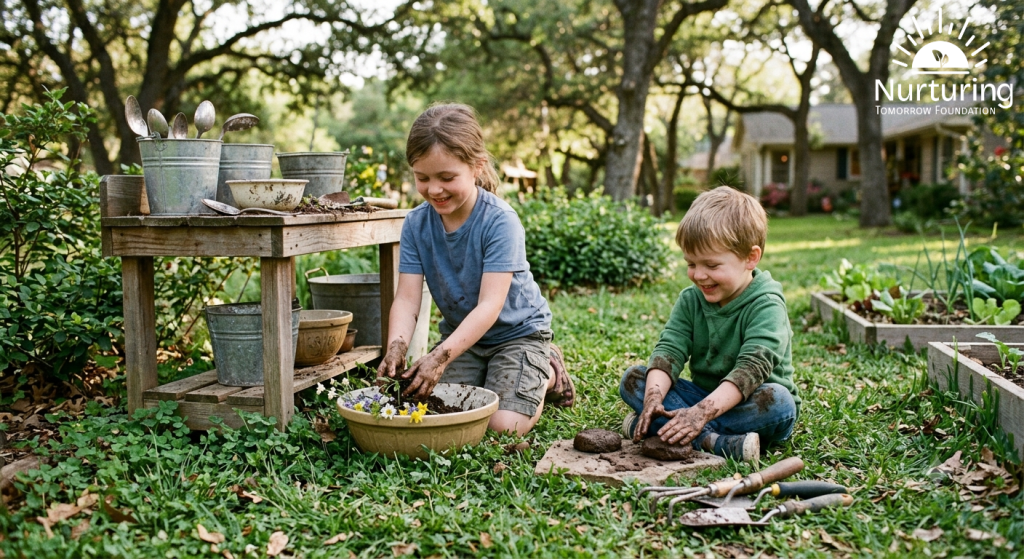
There is a particular kind of parental instinct that kicks in the moment a child’s hands hit the soil. Wipe it off. Wash it up. Keep the mud outside where it belongs.
It is an understandable reflex. But a growing body of research suggests that instinct might be working against something the body actually needs. Dirt, it turns out, is not simply the opposite of clean. For a developing child, it may be one of the more overlooked ingredients in a healthy mind.
This is not a metaphor. Scientists studying the connection between the gut, the immune system, and the brain have found that regular exposure to microbes in soil and other natural environments appears to shape children’s immune regulation and, increasingly, their mood.
The Gut-Brain Connection, in Plain Terms
The gut and the brain are in constant communication. Researchers call this relationship the microbiome-gut-brain axis, and it operates through a dense network of neural signals, hormones, and immune activity that runs in both directions between the digestive system and the central nervous system.
The gut is home to trillions of microorganisms, collectively called the gut microbiome, and these microbes do far more than aid digestion. They produce neurotransmitters, including a majority of the body’s serotonin, and they interact directly with the immune system in ways that influence inflammation throughout the body, including the brain.
A study published in Nature Communications in 2025 found that the composition of a child’s gut microbiome at age two predicted internalizing symptoms, such as anxiety and withdrawal, at school age, and that this relationship was mediated by measurable changes in brain connectivity. In other words, the microbial environment early in a child’s life appears to shape emotional development years later.
This is still an emerging field. Researchers are careful to note that correlation is not the same as full causation, and much of this research is ongoing. But the direction of the evidence is consistent enough that major research institutions, including the National Institute of Environmental Health Sciences, have begun funding further study specifically into how environmental exposures shape the gut-brain axis in children.
The Biodiversity Hypothesis
For decades, researchers have observed that children raised in more natural, microbially diverse environments, such as farms, tend to have lower rates of allergies, asthma, and other immune-related conditions than children raised in highly sanitized urban settings. This observation became known as the biodiversity hypothesis: the idea that reduced contact with diverse environmental microbes disrupts healthy immune development.
In 2020, Finnish researcher Dr. Marja Roslund and colleagues put that hypothesis to a real-world test. They took 10 urban daycare centers and transformed the play yards of several with forest-floor material, sod, and planting boxes, essentially bringing a slice of biodiverse nature into an ordinary daycare setting. Children spent about ninety minutes a day playing in these enriched yards.
After just twenty-eight days, the results were measurable. The children in the enriched yards showed increased diversity in their skin and gut microbiota, along with meaningful shifts in blood markers tied to immune regulation. Specifically, the intervention increased levels of regulatory T cells, the cells responsible for maintaining immune balance and preventing overreacting to harmless triggers. The study, published in the journal Science Advances, was the first human trial to demonstrate that deliberately increasing environmental biodiversity could shift a child’s immune function within weeks.
The children were not eating dirt or handling anything unsanitary. They were simply playing, as children have for most of human history, in an environment with a rich and varied microbial community.
The Serotonin Connection
Separately, researchers have identified a specific soil-dwelling bacterium, Mycobacterium vaccae, that appears to interact directly with mood regulation. Early studies found that exposure to this harmless bacterium activated serotonin-producing neurons in the brain, the same neurotransmitter pathway targeted by many antidepressant medications.
The discovery happened somewhat by accident. An oncologist in London was testing the bacterium as part of a lung cancer treatment and found that while it did not extend survival, patients who received it reported meaningfully improved mood and quality of life. That observation opened up a new area of research into how soil bacteria interact with the nervous system.
A separate randomized trial, known as the Play&Grow study, examined outdoor nature-related activities among preschool children and found associated changes in the gut microbiota, alongside reduced perceived stress and lower anger frequency among participating children. The researchers noted that gut bacteria influence the production of GABA, a calming neurotransmitter that plays a central role in anxiety regulation, and that shifts in the microbiome following exposure to nature may partially explain these mood effects.
None of this means dirt is a treatment for anxiety or depression. But it does suggest that the instinct to keep children in relentlessly sanitized environments, however well-intentioned, may be working against biological systems that evolved to expect regular contact with the natural world.
Why This Matters More Now Than Ever
Children today spend meaningfully less time outdoors, and in less biodiverse settings, than previous generations. Urban living, structured indoor schedules, and the broad cultural embrace of hand sanitizer and antibacterial everything have all reduced the microbial variety children encounter in daily life.
This shift lines up with what is sometimes called the old friends hypothesis, an evolution of the original hygiene hypothesis. The idea is that the human immune system evolved over hundreds of thousands of years in close contact with a wide range of environmental microbes. Those microbes are not intruders. They are old evolutionary companions that the immune system expects to encounter, and that help train it to respond appropriately rather than overreact.
When that contact is missing, particularly in early childhood, when the immune system is still calibrating, the body may be more prone to both physical immune conditions like allergies and asthma and possibly to the kind of low-grade systemic inflammation that researchers increasingly link to mood and behavioral difficulties.
This is a case where good intentions and biology are working at cross purposes. Parents are not wrong to want their children clean and healthy. The research simply suggests that, for a developing immune system, healthy includes some dirt.
Practical Ways to Bring More Dirt Into Daily Life
None of this requires a farm, a forest, or a radical change in lifestyle. Small, regular contact with natural environments appears to matter most.
Let outdoor play be actually dirty. Resist the urge to redirect a child away from digging, mud, or damp soil during outdoor time. A little dirt under the fingernails is not a hygiene failure. It may be exactly the kind of exposure the research points to as beneficial.
Prioritize green, textured outdoor spaces over pavement. A grassy yard, a wooded trail, or a garden bed offers more microbial diversity than a paved playground or a strictly maintained lawn. When possible, choose the more natural option.
Start a small garden together. Gardening combines soil contact, sunlight, and a meaningful shared activity. Even a few pots of vegetables or flowers on a porch introduce regular, low-stakes contact with soil microbes.
Skip the antibacterial reflex outdoors. Hand sanitizer has its place, particularly before eating or after specific exposures, but it does not need to be the default response to a child touching dirt, grass, or an outdoor surface. Plain soap and water after outdoor play is generally sufficient.
Make outdoor time a daily habit, not an occasional event. The daycare study that produced measurable immune changes involved children spending roughly ninety minutes a day outdoors over four weeks. Consistency, rather than a single big nature outing, appears to drive the biological benefit.
Consider a pet. Research on the hygiene hypothesis has long linked early childhood pet ownership to lower rates of allergic disease, likely through the same increased microbial exposure pathway. A family dog or cat may be doing more for a child’s developing immune system than it gets credit for.
A Note on Balance
This is not an argument against hygiene. Handwashing after using the bathroom, before eating, and after exposure to specific illnesses remains important and is not in tension with anything discussed here. The distinction researchers draw is between necessary hygiene practices and the broader trend toward sterilizing every surface a child might touch during ordinary play.
Children do not need to be dirty to be healthy. But they may need more regular, unremarkable contact with the natural world than modern life tends to offer.
A Note from the Nurturing Tomorrow Foundation
At the Nurturing Tomorrow Foundation, we believe that some of the best tools for supporting a child’s wellbeing are also the simplest. A yard. A garden bed. An afternoon outside without a schedule. The science is still developing, but the direction is clear enough to act on: nature is not just a nice backdrop for childhood. It may be a biological requirement.
Let the kids get dirty. Their bodies may thank them for it.
Sources
- Roslund MI, Puhakka R, Grönroos M, et al. “Biodiversity Intervention Enhances Immune Regulation and Health-Associated Commensal Microbiota Among Daycare Children.” Science Advances, October 2020. https://www.science.org/doi/10.1126/sciadv.aba2578
- Outdoor Play Canada. “Exposure to Natural Biodiversity Improves the Immune System of Day-Care Children After One Month,” November 2020. https://www.outdoorplaycanada.ca/2020/11/10/exposure-to-natural-biodiversity-improves-the-immune-system-of-day-care-children-after-one-month/
- Sobko T, Liang S, Cheng WHG, Tun HM. “Impact of Outdoor Nature-Related Activities on Gut Microbiota, Fecal Serotonin, and Perceived Stress in Preschool Children: The Play&Grow Randomized Controlled Trial.” Scientific Reports, 2020. https://www.nature.com/articles/s41598-020-78642-2
- “Childhood Gut Microbiome Is Linked to Internalizing Symptoms at School Age via the Functional Connectome.” Nature Communications, 2025. https://www.nature.com/articles/s41467-025-64988-6
- NIEHS Environmental Factor. “Environment’s Role in Gut-Brain Axis Explored at Council,” July 2025. https://factor.niehs.nih.gov/2025/7/feature/1-feature-microbiome-gut-brain-connection
- The Institute for Functional Medicine. “Can Our Connection to the Natural World Shape Our Microbiome?” https://www.ifm.org/articles/can-connection-natural-world-shape-microbiome
- Garden Betty. “What Soil Does to Your Brain When You Breathe In Mycobacteria,” April 2024. https://gardenbetty.com/getting-stoned-on-soil/
- Frontiers in Allergy. “The Hygiene Hypothesis for Allergy: Conception and Evolution.” https://www.frontiersin.org/journals/allergy/articles/10.3389/falgy.2022.1051368/full
- Tischer C, Kirjavainen P, Matterne U, et al. “Interplay Between Natural Environment, Human Microbiota and Immune System: A Scoping Review of Interventions and Future Perspectives Towards Allergy Prevention.” Science of the Total Environment, 2022. https://doi.org/10.1016/j.scitotenv.2022.153422
- Frontiers in Microbiomes. “The Gut-Brain Connection: Microbes’ Influence on Mental Health and Psychological Disorders,” December 2025. https://www.frontiersin.org/journals/microbiomes/articles/10.3389/frmbi.2025.1701608/full