


It starts somewhere around the second week of June.
The school-year structure evaporates, the kids are home, and within about forty-eight hours, a parent hears the two words that have the power to rearrange an entire afternoon: “I’m bored.”
The instinct is to fix it. Sign them up for camp. Find a class. Suggest an activity. Put on a show. Summer scheduling pressure is real, and for many parents, an unoccupied child feels like a problem to be solved. We live in a culture that treats busyness as a virtue and idleness as a warning sign, for kids no less than adults.
But the research tells a different story. A growing body of evidence suggests that unstructured time, the hours with no agenda, no coach, and no adult directing the outcome, may be one of the most developmentally valuable things a child can experience. And boredom, the feeling most parents scramble to prevent, turns out to be something of a superpower.
The Cost of the Overpacked Summer
Before exploring what free time builds, it helps to understand what too much structure takes away.
In a 2024 analysis published in the Economics of Education Review, researchers from the University of Georgia and the Federal Reserve Board examined the relationship between the number of enrichment activities in which children were enrolled and their mental health outcomes. Their finding was direct: beyond a certain point, more activities made things worse. Kids who were spending the most time in structured activities were more likely to report symptoms of anxiety, depression, and anger.
“We’re not saying that all these activities are bad,” said Carolina Caetano, one of the study’s authors. “But the total is bad.”
The problem, the researchers explained, is displacement. When every hour is scheduled, something has to give. Sleep suffers. Unstructured socializing shrinks. And the time children need to simply exist without performance pressure, to be kids and not students of something, disappears.
Psychologists have raised this concern for years. Studies consistently show that children who spend the most time in structured activities face greater challenges with self-directed executive function: the ability to set their own goals, manage their own attention, and solve problems without an adult telling them what to do next. These are not minor skills. They are the foundation of independent, resilient adulthood.
What Unstructured Play Is Actually Building
The American Academy of Pediatrics, in a clinical report reaffirmed in January 2025, called play “a singular opportunity to promote the social-emotional, cognitive, language, and self-regulation skills that build executive function and a prosocial brain.” Not structured play. Not enrichment programs. Play.
The distinction matters. Unstructured, child-directed play is categorically different from adult-led activity because the child controls it. They set the rules, negotiate with peers, recover when something goes wrong, and adapt when the game changes. None of that happens when an adult is running the show.
A landmark longitudinal study following more than 2,200 Australian children found that time spent in unstructured free play during the toddler and preschool years was a meaningful predictor of self-regulation skills two years later, even after controlling for other variables. The children who played freely were better able to manage their emotions, stay on task, and handle frustration when they were older.
The American Psychological Association, after reviewing decades of research, concluded that unstructured play directly builds resilience. Through free play, children “manage frustration, adapt to unexpected situations, and recover from setbacks,” developing the emotional vocabulary and self-regulation tools that structured activities rarely require.
A 2025 systematic review in the Journal of Intelligence examined twenty-five empirical studies on open-ended, child-led play and found consistent enhancements in problem-solving, divergent thinking, and academic readiness. The skills parents often sign their kids up for in enrichment programs are more reliably built in the backyard.
On Boredom Specifically
Boredom deserves its own defense, because it is not simply the absence of stimulation. Research suggests it may be an active cognitive state, one that pushes the brain toward something.
Dr. Sandi Mann, a psychologist who has studied boredom extensively, found that boredom stimulates the brain to seek out creative solutions. When the mind is not occupied by an external demand, it wanders, and wandering minds generate ideas, make unexpected connections, and imagine things that a structured task would never prompt. It is not a coincidence that some of the most creative people describe boredom as a regular feature of their childhoods.
Dr. Teresa Belton, a researcher at the University of East Anglia, has argued that the capacity to tolerate boredom is itself a developmental skill. Children who learn to sit with an unoccupied moment, rather than immediately reaching for a screen or waiting for an adult to redirect them, are building patience, frustration tolerance, and the ability to self-generate motivation. These are not trivial capacities. They are exactly the skills that predict success in school, relationships, and adult life.
The Child Mind Institute, in a 2024 review of the research on boredom and development, put it plainly: “The key is to help kids learn how to manage their boredom so they can develop independence and feel agency over their own happiness and well-being.”
That agency is the point. A child who learns to move from “I’m bored” to “I found something to do” without adult intervention has practiced something most enrichment programs never teach.
Why This Is Hard for Parents
Understanding the research is one thing. Tolerating the reality of a bored, restless child on a Tuesday afternoon in July is another.
Part of the difficulty is cultural. The pressure to optimize childhood, to fill time with activities that will build skills, look good, and ensure a good future, is genuinely intense. Parents who leave their kids unscheduled can feel like they are falling short. Seeing a neighbor’s summer activity roster can trigger the same anxiety that school enrichment schedules generate during the year.
Part of it is also relational. An unhappy, bored child tends to make noise about it. Sitting with that discomfort, rather than resolving it immediately, requires a kind of parental tolerance that runs counter to every caretaking instinct.
But the research is consistent: the discomfort is part of the point. Children who are rescued from boredom every time it surfaces never get the chance to work through it. And, working through it, it turns out that’s where the development happens.
Practical Ways to Create Real Free Time This Summer
The goal is not to do nothing. It is to create conditions where children can direct their own experience. A few practical ways to make that happen:
Protect at least one hour of true free time per day. Not screen time. Not scheduled play. Time where your child has no agenda and no adult directing them. This might feel uncomfortable at first for everyone. That is expected. Stick with it.
Say “figure it out” and mean it. When your child says they are bored, resist the reflex to generate a solution. A simple “I wonder what you could come up with” puts the creative burden back where it belongs. Most children, given enough time and no alternative, will find something.
Make the outdoor environment accessible. Research consistently links outdoor unstructured play to better mental health outcomes than indoor free time. A backyard, a porch, a local park: any outdoor space where a child can roam with a degree of freedom gives the added benefit of physical activity and natural sensory input. Even unstructured outdoor time as short as twenty minutes has been shown to reduce stress and improve mood.
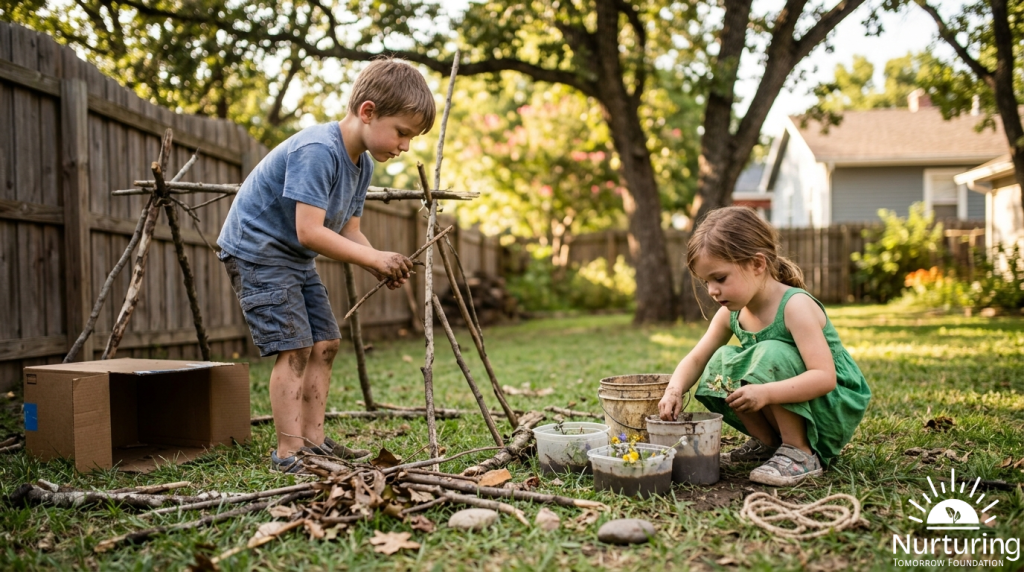
Resist over-curating the materials. Open-ended materials, sticks, dirt, water, cardboard boxes, craft supplies without instructions, support more creative thinking than toys with a defined purpose. A box of random supplies invites invention. A kit with directions produces a predetermined outcome.
Let the activity be low-stakes and impermanent. Children’s free play does not need to produce anything. A fort that falls down, a game that nobody wins, an afternoon spent doing something that looks purposeless from the outside: these are not wasted hours. They are developmental ones.
Audit the schedule honestly. If your child has scheduled activities most days of the week, that is worth examining. The research from the Economics of Education Review suggests asking a simple question: does your child have regular, reliable time that belongs entirely to them? If the answer is no, something can probably be cut.
When to Seek Support
Unstructured time is healthy for most children. But if your child struggles significantly with unoccupied time, shows persistent anxiety, is unable to tolerate boredom without distress, or withdraws from play and peers, that may be worth exploring with a pediatrician or child therapist.
Likewise, if your child shows ongoing signs of anxiety, depression, or emotional dysregulation regardless of how their time is structured, professional support is appropriate. Signs to watch for include:
- Persistent sadness, hopelessness, or irritability lasting more than two weeks
- Significant withdrawal from friends, family, or activities they previously enjoyed
- Changes in sleep or appetite with no clear cause
- Expressions of worthlessness or not wanting to be here
- Any mention of self-harm
If your child is in crisis, contact the 988 Suicide and Crisis Lifeline by calling or texting 988, available 24 hours a day, 7 days a week.
A Note from the Nurturing Tomorrow Foundation
At the Nurturing Tomorrow Foundation, we believe that some of the most important things we can offer children cost nothing and require no registration. Time is one of them.
This summer, consider what it might mean to give your child an hour with no plan — and see what they build with it. The research suggests you might be surprised. And so might they.
Sources
- Caetano C, Caetano G, Nielsen E. “Are Children Spending Too Much Time on Enrichment Activities?” Economics of Education Review, February 2024. https://doi.org/10.1016/j.econedurev.2023.102503
- The Hechinger Report. “Proof Points: Overscheduling Kids’ Lives Causes Depression and Anxiety, Study Finds,” February 2024. https://hechingerreport.org/proof-points-overscheduling-kids-lives-causes-depression-and-anxiety-study-finds/
- Yogman M, et al. “The Power of Play: A Pediatric Role in Enhancing Development in Young Children.” Pediatrics, American Academy of Pediatrics. Reaffirmed January 2025. https://publications.aap.org/pediatrics/article/142/3/e20182058/38649/The-Power-of-Play-A-Pediatric-Role-in-Enhancing
- American Psychological Association. “The Many Wondrous Benefits of Unstructured Play,” September 2023. https://www.apa.org/topics/children/kids-unstructured-play-benefits
- Waldorf Education North America. “The Essential Benefits of Play: A Research-Based Perspective,” February 2026. https://www.waldorfeducation.org/the-essential-benefits-of-play-a-research-based-perspective/
- Engel S, et al. “Free Play Predicts Self-Regulation Years Later: Longitudinal Evidence from a Large Australian Sample of Toddlers and Preschoolers.” Early Childhood Research Quarterly, 2021. https://www.sciencedirect.com/science/article/pii/S0885200621001411
- Child Mind Institute. “The Benefits of Boredom,” updated November 2024. https://childmind.org/article/the-benefits-of-boredom/
- Safari Ltd. “The Benefits of Boredom for Kids: Unlocking Creativity and Building Resilience,” June 2025. https://www.safariltd.com/blogs/toys-that-teach/the-benefits-of-boredom-for-kids-unlocking-creativity-building-resilience-and-cultivating-life-skills
- SolutionHealth. “Overbooked Kids: The Overscheduled Crisis,” June 2024. https://www.solutionhealth.org/2024/06/04/overbooked-kids-the-overscheduled-epidemic/
- National Education Association. “Study: Too Many Enrichment Activities Harm Mental Health,” April 2024. https://www.nea.org/nea-today/all-news-articles/study-too-many-enrichment-activities-harm-mental-health