


When a teenager feels anxious, overwhelmed, or sad, the last thing many of them will do is knock on a parent’s door and start talking. A growing number of them will, however, open an app.
Nearly one in five young Americans, an estimated 8.2 million people between the ages of 12 and 21, reported using AI chatbots like ChatGPT, Gemini, and Character.AI for mental health advice in 2025, according to a nationally representative study published in JAMA Pediatrics in June 2026. That is up from 13 percent just one year earlier, a 47 percent increase in twelve months.
The temptation when reading those numbers is to panic about technology. To frame it as a story about AI replacing therapists, or about kids disappearing into their screens instead of asking for real help.
But the more interesting story, and the more useful one for parents and caregivers, is the one those numbers are quietly pointing to. It is not a story about chatbots. It is a story about trust.
What the Research Actually Found
The RAND study, which surveyed 1,009 adolescents and young adults through a nationally representative panel in November 2025, found more than just a headline number. Several of its supporting findings reframe the picture entirely.
Among young people who used AI chatbots for mental health support, 63 percent said they had not told anyone; not a parent, not a doctor, not even a friend. They were not choosing chatbots over people. They were choosing chatbots instead of saying anything at all. When they did disclose to someone, friends were the most common confidants, cited by 28 percent of users. Trusted adults, such as parents, teachers, and counselors, came in at just 16 percent.
Then there is the detail that flips the narrative. Youth who had spoken with a physician about their mental health in the previous six months were almost twice as likely to also report using AI chatbots for mental health advice. In other words, chatbot use was not a sign that kids were avoiding the mental health system. It was more common among kids who were already engaged with it.
That paints a different picture. These are not kids who are replacing professional support with an app. Many of them are kids who are actively trying to get help, and using every available outlet to do so.
Why Chatbots Feel Safe
To understand why a teenager would rather type their feelings into a phone than say them out loud, it helps to understand what makes human conversation feel risky to a young person.
It is not always stigma, at least not in the traditional sense. Research from The Jed Foundation, based on a national survey of more than 1,500 teenagers, found that stigma does not rank among the top factors holding teens back from asking for help. The bigger barriers are more relational: fear of not being understood, discomfort with emotional conversations, and worry about being a burden to the people they love.
A chatbot, by contrast, is available at any hour, never visibly tired or distracted, and carries no risk of an awkward dinner conversation afterward. It does not get worried or upset. It does not call someone. It does not judge. For a teenager who is not sure whether what they are feeling “counts” as a real problem, or who is afraid of making things worse by bringing it up, that frictionless availability is hard to compete with.
As one teen put it in a 2025 state-level youth mental health report: “It’s not that we don’t want help. We just don’t trust the systems offering it.”
The Risks Are Real — And Parents Should Know Them
None of this means chatbots are a good substitute for human support or professional care. The research is clear: they are not, and, in some cases, they can cause harm.
A November 2025 assessment by Common Sense Media, conducted in partnership with Stanford Medicine’s Brainstorm Lab for Mental Health Innovation, found that leading AI platforms consistently fail to recognize and respond appropriately to mental health conditions among young people. Despite relative competence in areas like homework help, chatbots can give teens the false impression that they are receiving quality mental health guidance when they are not.
The American Psychological Association issued a health advisory warning that generative AI chatbots should not be relied on to deliver psychotherapy, and called specifically for safeguards for minors and other vulnerable users.
Chatbots are designed to keep users engaged. They ask follow-up questions, use memory to create a sense of ongoing relationship, and tend toward validation, affirming whatever the user says rather than offering the kind of honest, calibrated response a trained counselor would provide. That agreeableness can feel supportive while quietly delaying real intervention.
In a handful of tragic and widely reported cases, prolonged chatbot interactions appear to have reinforced rather than interrupted self-destructive thinking in teenagers in crisis. Character.AI, one of the most popular platforms, announced in late 2025 that it was cutting off teen access following lawsuits and congressional scrutiny, a sign that even the industry is beginning to reckon with what it created.
The American Medical Association, citing the JAMA Pediatrics study, called on Congress to act. “Promise without guardrails is not progress,” researchers wrote. “It’s risk.”
What This Means for Parents and Caregivers
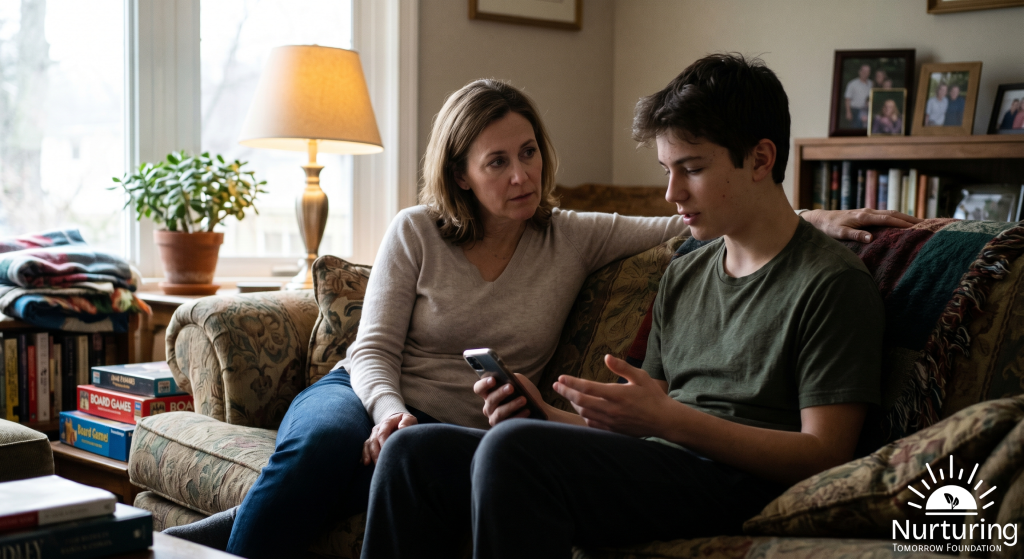
Here is the reframe that matters most: if your teenager is talking to a chatbot about their mental health, that is not a sign of failure on your part or theirs. It is a signal. They are trying to process something real. The question is whether there is a path from that chatbot conversation to a human one.
Research from The Jed Foundation found that teens are most likely to reach out to an adult when they feel the adult will listen without judgment and, when possible, keep the conversation confidential. That bar is actually quite achievable, and it starts long before a crisis.
Start the conversation before they need it. Kids who have already talked about mental health with a parent in low-stakes moments are far more likely to come back when things get hard. Normalize the topic early, often, and without drama.
Ask about AI use without interrogating. The American Psychological Association recommends approaching chatbot conversations with curiosity rather than alarm. Ask what apps your teen uses and what they like about them. If they mention using one for emotional support, that is a door, not a threat.
Model what it looks like to ask for help. If teens only ever see adults act as if they have everything under control, then asking for help feels like weakness. Letting your kid see you acknowledge stress and how you handle it teaches them that seeking support is a sign of strength.
Make “are you okay?” feel safe. The goal is not to get a full emotional download every time. It is to be someone your kid believes will handle what they share without panicking, punishing, or spiraling. Even an imperfect conversation is better than silence.
Know the warning signs. Increased withdrawal, changes in sleep or appetite, giving away belongings, expressions of hopelessness or worthlessness, and a sudden calm after a period of distress all warrant immediate attention. Trust your instincts. If something feels wrong, it is worth saying so; directly and without waiting for your teen to bring it up first.
Connect them to professional support. School counselors, pediatricians, and telehealth platforms can all serve as entry points. The JAMA Pediatrics study found that teens who had already spoken with a physician were more likely to be actively seeking mental health support through multiple channels, meaning that one conversation with a doctor can open more doors than it closes.
When to Seek Immediate Help
If your child expresses thoughts of self-harm or suicide, do not wait. Contact the 988 Suicide and Crisis Lifeline by calling or texting 988, available around the clock. You can also reach the Crisis Text Line by texting HOME to 741741.
If you believe your child is in immediate danger, call 911 or take them to the nearest emergency room.
A Note from the Nurturing Tomorrow Foundation
At the Nurturing Tomorrow Foundation, we believe that the adults in a child’s life, not the apps, are the most powerful protective factor for a young person. Technology will keep changing. The need for human connection will not.
If your child is looking for support wherever they can find it, that is not something to fear. It is something to meet. Our mission is to help families build the kind of trust and communication that makes turning to a parent feel as natural, and as safe, as picking up a phone.
Sources
- McBain RK, Cantor JH, Breslau J, et al. “AI Chatbot Use and Disclosure for Mental Health Among US Adolescents and Young Adults.” JAMA Pediatrics. Published online June 1, 2026. doi:10.1001/jamapediatrics.2026.2015 — via RAND: https://www.rand.org/pubs/external_publications/EP71278.html
- AJMC. “AI Chatbot Use for Mental Health Advice Rises Sharply Among US Youth, With Key Disparities Identified,” June 2026. https://www.ajmc.com/view/ai-chatbot-use-for-mental-health-advice-rises-sharply-among-us-youth-with-key-disparities-identified
- The Jed Foundation. “Unraveling the Stigma: Exploring Barriers to Mental Health Support Among U.S. Teens,” May 2024. https://jedfoundation.org/unraveling-the-stigma-report/
- AIM Youth Mental Health. “State of Youth Mental Health 2025: California Teens Are Demanding a Mental Health Revolution,” May 2025. https://aimymh.org/state-of-youth-mental-health-2025-california-teens-are-demanding-a-mental-health-revolution/
- Common Sense Media. “Common Sense Media Finds Major AI Chatbots Unsafe for Teen Mental Health Support,” November 20, 2025. https://www.commonsensemedia.org/press-releases/common-sense-media-finds-major-ai-chatbots-unsafe-for-teen-mental-health-support
- American Psychological Association. “Your Teen Turned to AI Instead of You. What Experts Say Parents Can Do,” February 2026. https://www.apa.org/topics/artificial-intelligence-machine-learning/teens-chatbots-parents
- The Advisory Board. “AMA Sounds the Alarm Over Youths Turning to AI for Mental Health Advice,” June 2026. https://www.advisory.com/daily-briefing/2026/06/08/ai-chatbots
- Giovanelli A, Roundfield KD. “Adolescent Vulnerability to Consumer Chatbots — Artificial Agents and Genuine Risk.” JAMA Network Open. 2025;8(10):e2539028. https://jamanetwork.com/journals/jamanetworkopen/fullarticle/2840497
- Child Mind Institute. “AI Chatbots and Teens,” updated March 2026. https://childmind.org/article/ai-chatbots-and-teens/
- BBC News. “Character.ai to ban teens from talking to its AI chatbots.” https://feeds.bbci.co.uk/news/articles/cq837y3v9y1o